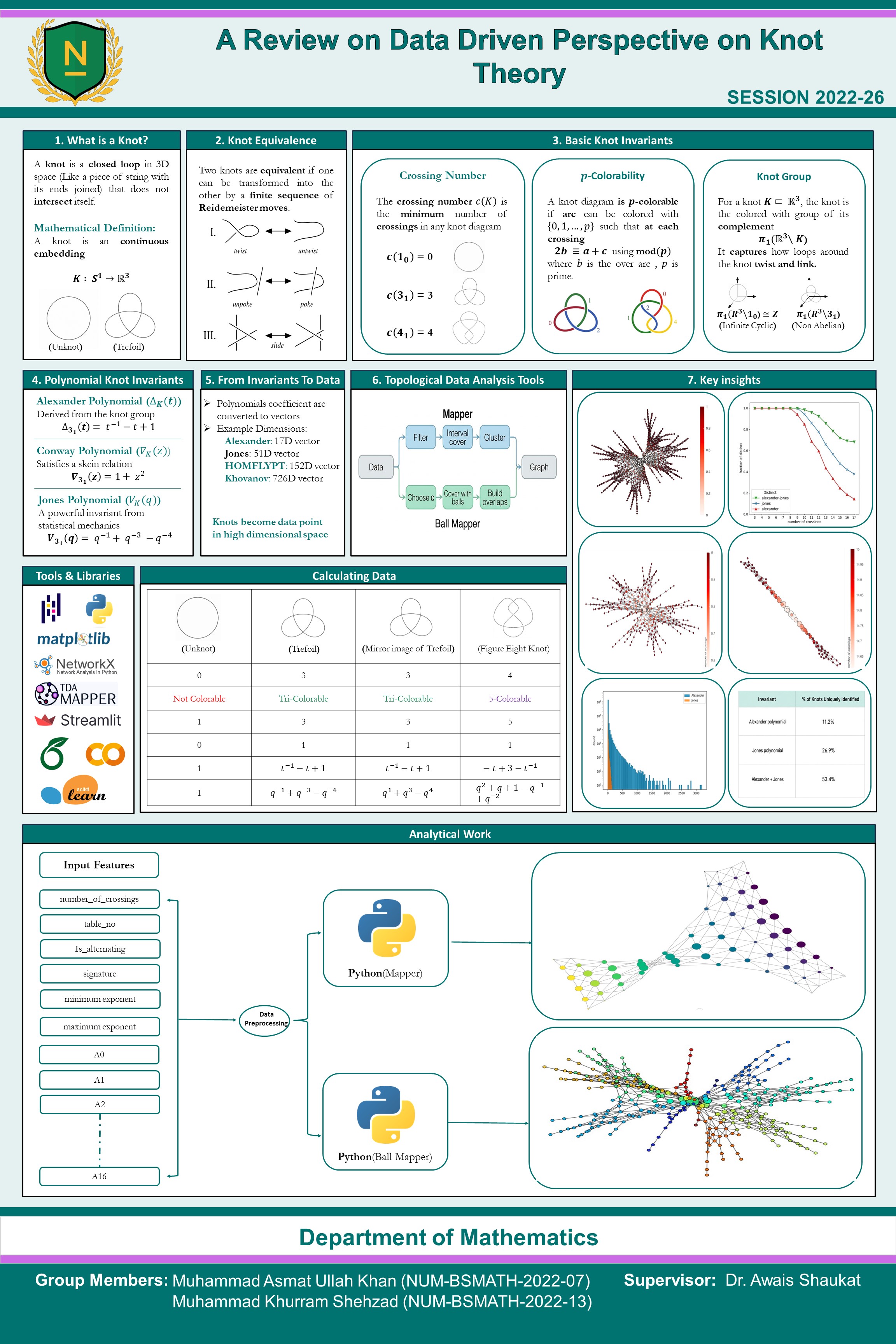
This project presents a data-driven perspective on Knot Theory by combining concepts from Algebraic Topology, Knot Invariants, and Topological Data Analysis (TDA). The theoretical foundation covers essential topological concepts such as paths, loops, homotopy, deformation retracts, fundamental groups, knot equivalence, and polynomial invariants including Alexander, Conway, and Jones polynomials. These invariants are used to distinguish and classify different knot structures mathematically. In the analytical phase, knot properties such as crossing number, alternation, signatures, polynomial coefficients, and colorability were transformed into high-dimensional numerical feature vectors. These vectors were then analyzed using Topological Data Analysis techniques, particularly Mapper and Ball Mapper, implemented in Python. Libraries including KeplerMapper, PyBallMapper, NetworkX, NumPy, Pandas, Matplotlib, and Scikit-learn were used for preprocessing, clustering, graph construction, and visualization. The project investigates how topological structures and clustering patterns emerge from knot invariant data. By converting abstract knot properties into analyzable datasets, the study demonstrates how computational topology and data science can reveal hidden relationships among knots. The resulting Mapper and Ball Mapper graphs provide insights into connectivity, similarity, and structural organization within knot datasets, creating a bridge between classical knot theory and moder
Tools: matplotlib,TDA Mapper,Streamlit,Google Colab,Scikit-Learn,Overleaf,Python
Department: Department of Mathematics
Poster