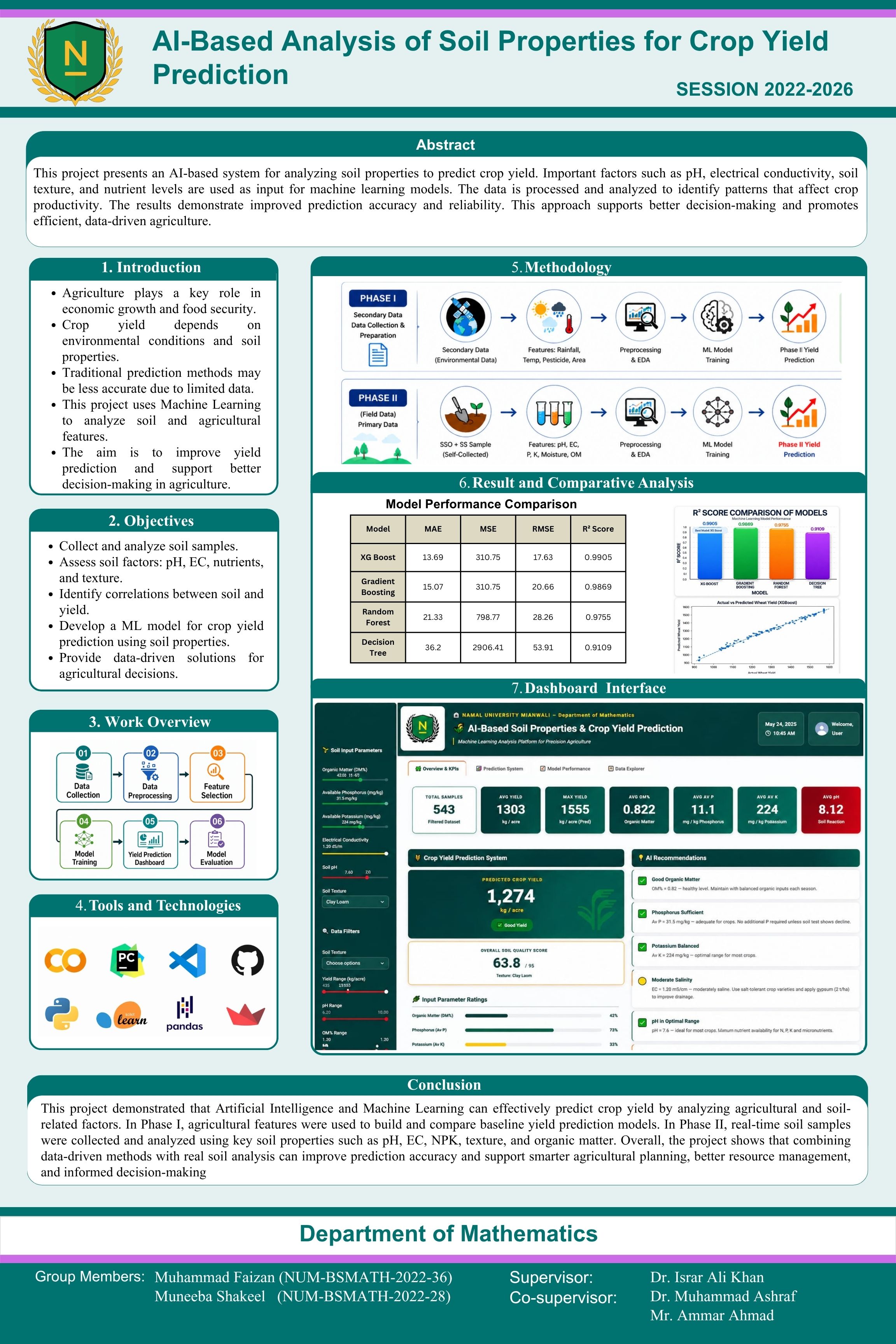
This project presents an AI-based system for analyzing soil properties to predict crop yield accurately and efficiently. Agriculture is a key sector for food production and economic growth, where crop productivity depends on soil and environmental conditions. Traditional yield estimation methods are often slow and inaccurate due to manual analysis. To overcome this, Artificial Intelligence and Machine Learning techniques are used to develop a data-driven prediction model. Important soil parameters such as pH level, electrical conductivity, soil texture, nitrogen, phosphorus, and potassium are used as input features, which are analyzed to understand their impact on crop growth and yield. The dataset is preprocessed through cleaning, handling missing values, normalization, and feature selection to improve performance. The system is implemented in Python using Scikit-learn, Pandas, NumPy, and Matplotlib, while machine learning models such as Random Forest and XGBoost are used for training and evaluation to identify hidden patterns in soil data and improve prediction accuracy and reliability. An interactive Streamlit dashboard allows users to manually input soil parameters and obtain crop yield predictions through a simple interface. The results show that the proposed approach performs better than traditional methods, supporting precision agriculture, improving decision-making, and promoting efficient and sustainable farming practices.
Tools: Python,PyCharm,Streamlit,Scikit-learn,Pandas,Matplotlib,Google Colab
Department: Department of Mathematics
Poster