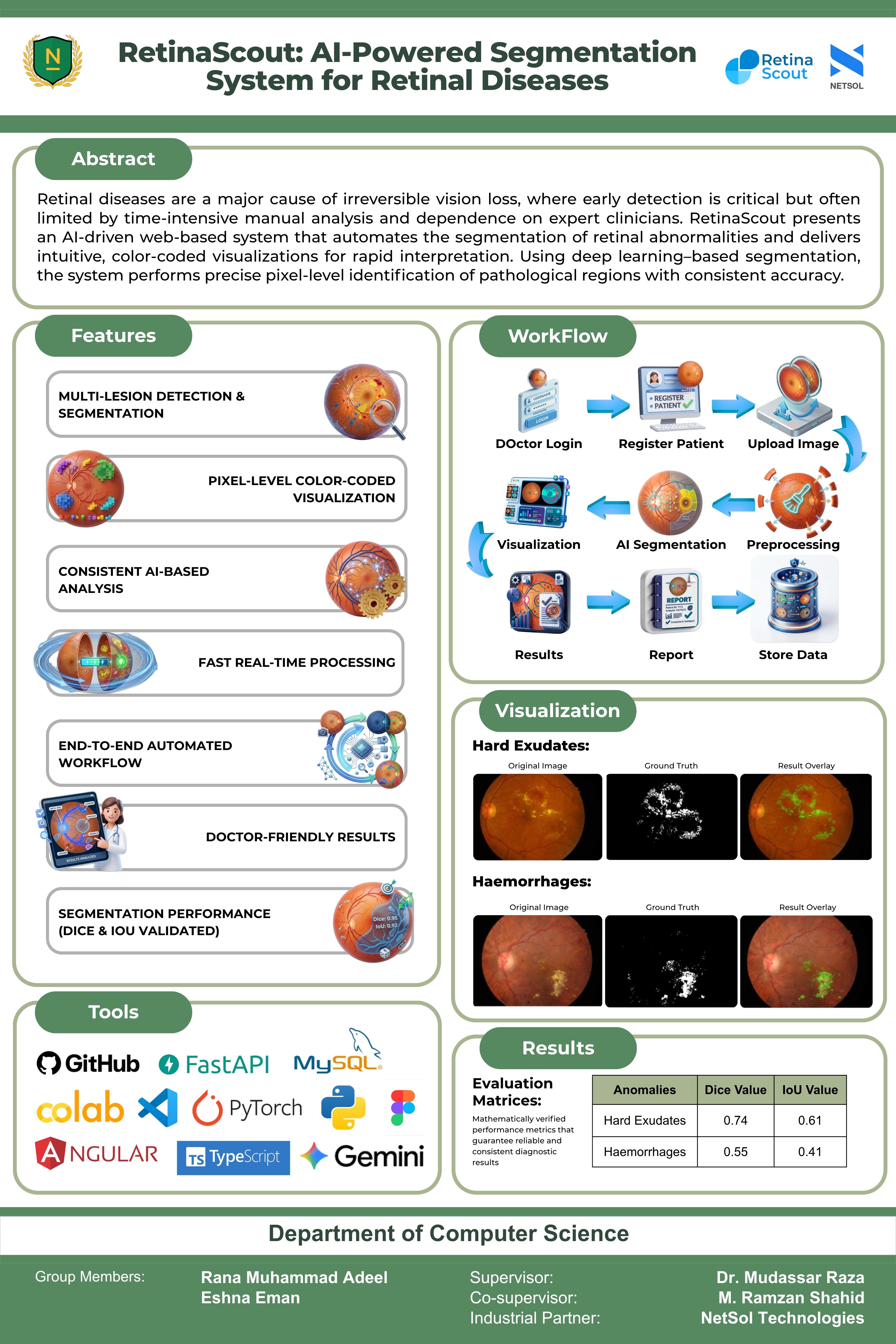
Retinal diseases remain a major cause of preventable blindness worldwide, yet manual screening creates a significant burden on healthcare systems. This traditional approach is labor-intensive, time-consuming, and often inconsistent, especially in regions where specialists are limited. RetinaScout addresses this challenge through an automated medical image segmentation system powered by a U-Net Convolutional Neural Network (CNN). Designed for the early detection of Diabetic Retinopathy (DR), the system performs pixel-level segmentation on fundus photography to identify critical pathological markers such as hemorrhages, microaneurysms, exudates, and the optic disc. The methodology utilizes the Indian Diabetic Retinopathy Image Dataset (IDRiD), enhanced by CLAHE preprocessing and data augmentation to improve model robustness. Performance is validated through Dice Coefficient and IoU metrics. Beyond the algorithm, RetinaScout features a secure web-based application with dedicated portals for Lab Technicians, Doctors, and Patients. To maintain high resolution without sacrificing speed, the system employs a patch-based processing technique (512 x 512 pixels), delivering results in just 1-2 minutes on standard GPUs. By combining deep learning accuracy with intuitive color-coded overlays and side-by-side visualizations, RetinaScout enhances the screening process, reducing clinician workload and supporting faster, more reliable intervention.
Tools: Angular,PyTorch,Python,MySQL,Figma,GitHub,VSCode,FastAPI
Department: Department of Computer Science
Poster