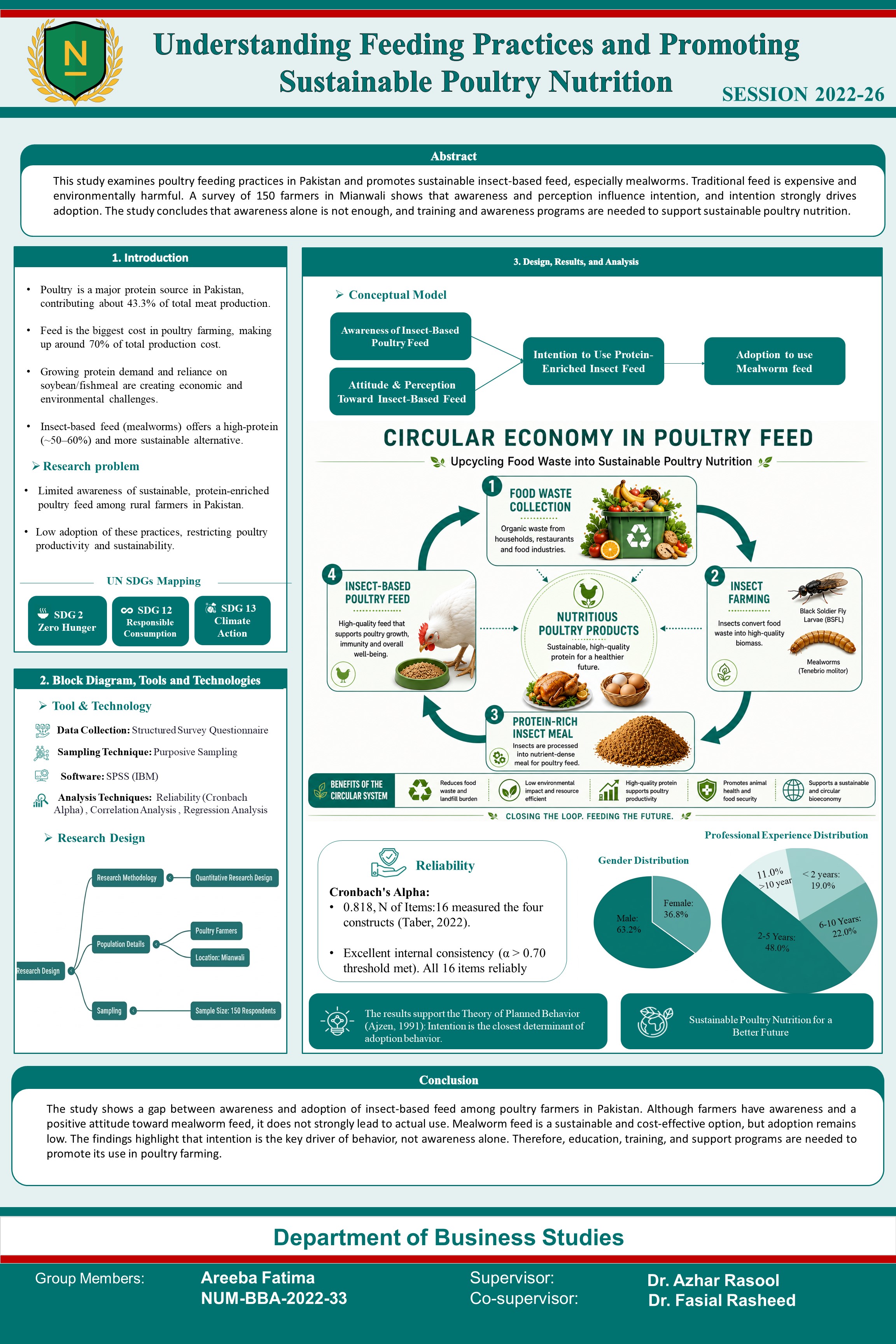
This study investigates the behavioral determinants of mealworm-enriched poultry feed adoption among rural smallholder farmers in Mianwali, Pakistan. Despite growing global evidence supporting insect-based feeds as nutritionally superior and environmentally sustainable alternatives to conventional soybean and fishmeal, adoption rates in developing agricultural contexts remain critically low. Grounded in the Theory of Planned Behavior and the Diffusion of Innovations framework, this study examines how awareness of insect-based feed and attitudes toward it influence adoption willingness, with behavioral intention serving as a mediating variable. Primary data were collected from 150 poultry farmers using a structured questionnaire. Reliability analysis returned a Cronbach Alpha of 0.818, confirming instrument validity. Descriptive statistics revealed a concerning pattern: awareness scored highest (M=3.49) while actual adoption willingness scored lowest (M=2.29), indicating a substantial intention-action gap. Regression analysis confirmed that intention was the sole significant direct predictor of adoption (β=0.479, p<.001), while awareness and attitude lost significance once intention entered the model, confirming full mediation. Both awareness and attitude significantly predicted intention independently. These findings reveal that knowledge alone is insufficient to drive behavioral change among rural Pakistani farmers. Targeted extension services, community-based awareness camp
Tools: Structured Questionnaire,Purposive Sampling technique,SPSS Software,Canva,MSOffice
Department: Department of Business Studies
Poster